
TL;DR
A 16-year-old varsity volleyball player from New York had strong technical ability but struggled with negative self-talk, lost focus, and physical tension during competition. Her family had invested in clinics, camps, private lessons, and traditional talk therapy, yet one mistake could still affect the rest of her game. After beginning virtual work with Leticia Oliveira, the athlete became better able to reset after errors, stay engaged, and compete with greater confidence. Coaches and mentors noticed the change, and she earned a place in the first-string lineup. This is one family’s experience, not a promise of identical results.
Before
One error could trigger tension, self-criticism, and a loss of focus for the rest of the game.
The work
Virtual hypnosis and coaching focused on confidence, attention, physical ease, and a faster reset.
After
She recovered from mistakes, stayed mentally present, and moved into the first-string lineup.
Table of Contents
Your daughter may look confident during warmups and become a different player after the first mistake. A missed serve tightens her shoulders. A shanked pass becomes proof that she does not belong. She watches the coach, worries about being pulled, and carries one point into the next rotation. From the stands, everyone can see the talent. Inside the athlete, attention has already left the game.
This is one reason families can spend years adding more instruction without solving the problem they are actually seeing. Technique matters, but a technically capable athlete still needs access to that technique while being watched, evaluated, tired, and emotionally activated.
Privacy note: The athlete’s name, school, team, position, and other identifying details are omitted. This case study describes one client’s reported experience, and individual results vary.
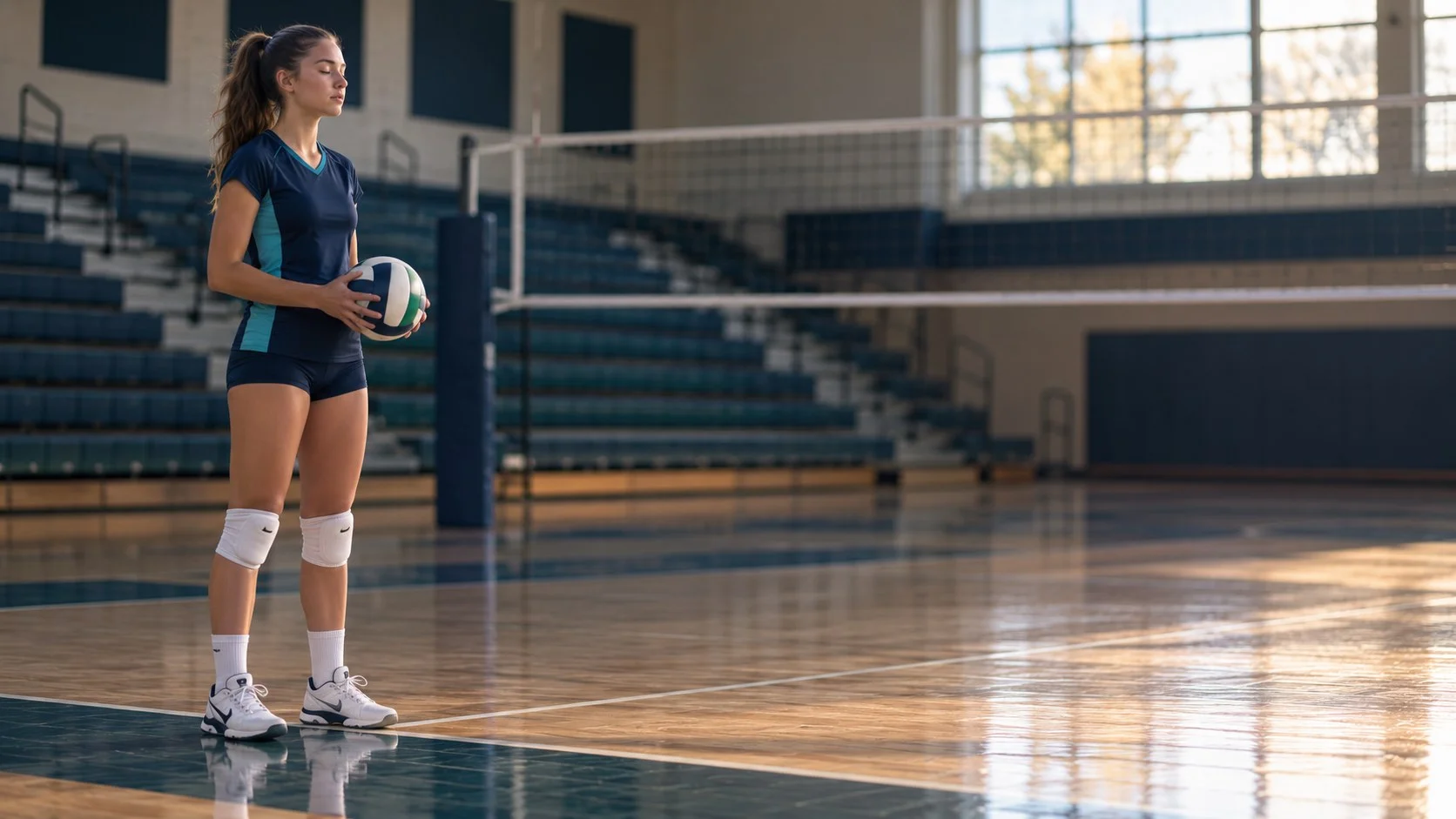
When Natural Ability Is Not Enough
For years, this 16-year-old New York volleyball player heard a frustrating version of the same message. Coaches saw unusual natural ability. They believed she had the physical potential to become a Division I athlete if that was the path she wanted. The obstacle was not whether she could learn the skill. It was whether she could stay mentally available long enough to use it.
During competition, negative self-talk gathered speed. Her body became tense. Focus narrowed in the wrong direction, toward the previous mistake, the coach’s expression, or the possibility of making another error. A single bad play could influence an entire set or game.
This pattern is sometimes mistaken for a lack of effort. In reality, the athlete may be trying too hard. She monitors her movement, forces the next play, and searches for immediate reassurance. The harder she attempts to guarantee the outcome, the less freely her practiced skill can emerge.
They Tried More Training and Traditional Therapy
Her parents did what caring parents often do. They invested in clinics, boot camps, private lessons, and more opportunities to practice. Each resource added knowledge and repetition. None fully changed the automatic spiral that appeared during a match.
The family also tried traditional talk therapy. Talk therapy can be valuable, especially when a young person is dealing with anxiety, depression, trauma, an eating disorder, or another mental health concern. It should not be dismissed simply because one performance pattern remained. In this athlete’s case, understanding the issue intellectually had not yet translated into a dependable on-court response.
That distinction matters. A player can understand that one error does not define her and still feel her chest tighten when it happens. She can know she should move on while her mind keeps replaying the point. The family was not looking for another explanation. They were looking for a way to practice a different automatic response.
A Reluctant Yes to Virtual Sessions
Because the family lived in New York and Leticia Oliveira practices from San Diego, the sessions would be virtual. The athlete’s mother was understandably reluctant. Parents often wonder whether their teenager will connect through a screen, whether hypnosis requires being in the same room, and whether an online appointment can hold a young athlete’s attention.
Hypnosis does not depend on a practitioner physically controlling the client. It uses communication, attention, imagery, and suggestion. A quiet private room, a stable connection, appropriate parental involvement, and a clear plan can make virtual work practical for many families.
Research on virtual hypnosis specifically for youth athletic performance is still limited. It would be inaccurate to say that online and in-person sessions are proven identical for every goal. Still, pediatric research shows that guided and technology-delivered hypnosis can be feasible in other settings. For example, a 2025 feasibility study found that an online, audio-based hypnotherapy program was acceptable to children and adolescents with disorders of gut-brain interaction. That does not prove a volleyball outcome, but it shows that young people can engage meaningfully with remotely delivered hypnotic exercises.
What Changed on the Court
The most meaningful change was not that she stopped making mistakes. Every volleyball player misses serves, mistimes blocks, and misreads plays. The change was that a mistake no longer had the same power to take over the rest of her game.
- She became better able to release the previous point and return attention to the next play.
- Her body carried less unnecessary tension during competition.
- Negative self-talk became less controlling and easier to redirect.
- She stayed more engaged when the score or momentum changed.
- Her confidence became connected to preparation and response, not perfect execution.
The difference was visible beyond the family. Coaches and mentors noticed a significant change in her mental state on the court. She was moved into the first-string lineup. That promotion matters, but it is not the whole result. The deeper gain was that her mental game began supporting the natural ability others had recognized for years.
No responsible practitioner can promise a lineup change, scholarship, or Division I recruitment. Team decisions depend on coaching, competition, health, skill, position needs, academics, and many other factors. This athlete’s experience shows what can become possible when performance is no longer repeatedly derailed by the same mental pattern.
Why Volleyball Is Also a Mental Game
Volleyball gives an athlete very little time to hide from a mistake. Points arrive quickly, rotations continue, and teammates depend on each player’s response. A server must commit after an error. A passer must read the next ball while the last contact is still emotionally fresh. Mental recovery is therefore not an abstract wellness goal. It is part of performance.
A field study of 81 college volleyball players found that motivation, tirelessness, calm, vigor, confidence, and concentration all correlated with competition performance. Mental energy predicted 23% of the variance in receivers’ performance in that sample. The players were adult men, so the exact result should not be transferred directly to a teenage girl, but the study demonstrates that mental factors can relate to objective volleyball performance.
Research with younger players also identifies competitive anxiety and confidence as relevant. A study of young volleyball players reported that cognitive anxiety was more prominent than physical anxiety and examined meaningful age and gender differences in self-confidence. A 2024 study of adolescent female volleyball players found that the group losing a championship match was more anxious on average, while also emphasizing that performance anxiety is influenced by many biological, psychological, and social factors.
Self-talk deserves similar care. A meta-analysis of 32 sport studies found a moderate positive effect of self-talk interventions on task performance. Training mattered. A separate systematic review of 47 studies recommended avoiding simple thought-stopping and found that negative self-talk did not uniformly impair performance. The useful target is not a perfectly positive mind. It is a trained response that directs attention where the athlete needs it.
Mental toughness is not pretending a mistake did not happen. It is noticing the reaction, taking any useful information, and becoming available for the next ball.
Why Young People May Respond Well to Hypnosis
It is common to hear that children respond better because their minds are more open or because they have less life experience stored in the brain. That explanation is too simplistic. The more defensible research-based explanation involves imagination, absorption, learning, and development.
A review of hypnosis in child psychiatry reported that children are often more readily hypnotized than adults and that hypnosis fits developmental strengths in fantasy and imagination. The authors also cautioned that much of the literature consisted of small studies and case reports, so more research was needed.
The American Academy of Pediatrics clinical report on mind-body therapies, reaffirmed in 2024, states that children and adolescents can learn to voluntarily influence processes such as breathing, muscle activity, and aspects of physiological regulation. It describes clinical hypnosis as an established adjunctive modality that should be individualized and delivered by appropriately trained professionals within their scope of practice.
Young athletes already use imagination constantly. They replay mistakes, anticipate reactions, picture serves, and feel future outcomes before they happen. Hypnosis does not insert imagination where none exists. It can help organize that capacity around a chosen response.
- Confidence: rehearse behaving with commitment even when certainty is incomplete.
- Focus: practice returning attention to one or two immediate volleyball cues.
- Physical tension: recognize the difference between useful readiness and unnecessary bracing.
- Recovery: connect a breath, word, or movement with releasing the previous point.
- Self-talk: replace global judgments with short instructions that help the next action.
Responsiveness still varies. Age alone does not guarantee a result. Trust, motivation, rapport, developmental fit, the athlete’s own goals, family support, and the practitioner’s skill all matter.
What Parents Should Look for Before Choosing Mindset Help
A teenager should not be treated like a performance project. The athlete needs a voice in the goal and a clear understanding of what sessions involve. Parent enthusiasm cannot replace the young person’s willingness to participate.
- Be cautious of anyone guaranteeing playing time, recruitment, or a particular level of competition.
Performance hypnosis can complement excellent coaching. It cannot replace the repetitions required to serve, pass, set, hit, block, move, and communicate. Its role is to help the athlete access practiced skill with less interference and recover more effectively when a point does not go as planned.
Mindset Support for Young Athletes
Learn more about hypnosis for athletic performance and HypnoCoaching at Easy Way To Live Well. Virtual sessions make this work accessible to families outside San Diego, subject to suitability and applicable requirements.
Frequently Asked Questions
Can hypnosis help a teenage athlete with mental toughness?
Hypnosis may help a willing young athlete rehearse confidence, focus, physical calm, and recovery after mistakes. Results vary, and it should complement technical coaching and appropriate healthcare rather than replace them.
Are teenagers easier to hypnotize than adults?
Research reviews report that children are often highly responsive to hypnosis, partly because imagination and absorption fit their developmental strengths. Responsiveness varies by person, and age alone does not guarantee an outcome.
Can virtual hypnosis work for a young athlete?
Many hypnotic methods rely on communication, attention, and imagery rather than physical proximity. Research specifically on virtual hypnosis for youth sports is limited, but remote pediatric hypnosis programs in other settings show that young people can engage with guided online methods.
Will hypnosis stop every negative thought?
That is not the goal. A useful program helps the athlete notice an unhelpful thought without letting it direct the next play, then return attention to a practiced cue.
Can hypnosis help an athlete recover after a bad play?
Recovery can be rehearsed as a repeatable sequence involving breath, posture, a cue word, and attention to the next responsibility. Hypnosis may help that sequence become more familiar and easier to access under pressure.
Does hypnosis guarantee more playing time or college recruitment?
No. Playing time and recruitment depend on many factors, including skill, health, academics, team needs, coaching decisions, and competition. No ethical practitioner should guarantee a scholarship, starting position, or performance result.
Where does Leticia work with athletes?
Easy Way To Live Well offers virtual sessions and in-person appointments at 4445 Eastgate Mall, Suite 200, San Diego, CA 92121 in La Jolla/UTC and 2650 Camino Del Rio N, 1st Floor, San Diego, CA 92108 in Mission Valley.
Help Your Athlete Access the Skills She Already Has
If your travel or varsity athlete has the technique but loses confidence, focus, or physical ease after a mistake, another clinic may not address the entire pattern. Mental performance can be trained too.
A discovery call gives parents and athletes a chance to ask questions about virtual sessions, suitability, goals, privacy, and what individualized HypnoCoaching may involve.
Sources
- American Academy of Pediatrics: Mind-Body Therapies in Children and Youth – Reviews pediatric hypnosis, guided imagery, self-regulation, evidence, and safeguards.
- PubMed: Hypnotherapy in Child Psychiatry – Reviews children’s hypnotic responsiveness, imagination, clinical uses, and evidence limitations.
- PubMed: Online Hypnotherapy Exercises for Children and Adolescents – Reports feasibility and preliminary outcomes from a pediatric online program outside sport.
- PubMed: Mental Energy and Volleyball Competition Performance – Examines relationships among confidence, concentration, calm, and objective volleyball performance.
- PubMed: Competitive Anxiety and Confidence in Young Volleyball Players – Examines cognitive anxiety, physical anxiety, confidence, age, and gender.
- PubMed: Performance Anxiety in Adolescent Female Volleyball Players – Studies psychological and physiological factors during a championship match.
- PubMed: Self-Talk and Sports Performance Meta-Analysis – Reviews 32 studies and reports a moderate positive effect for self-talk interventions.
- PubMed: Effects of Self-Talk Systematic Review – Reviews 47 studies and cautions against simplistic thought-stopping approaches.