
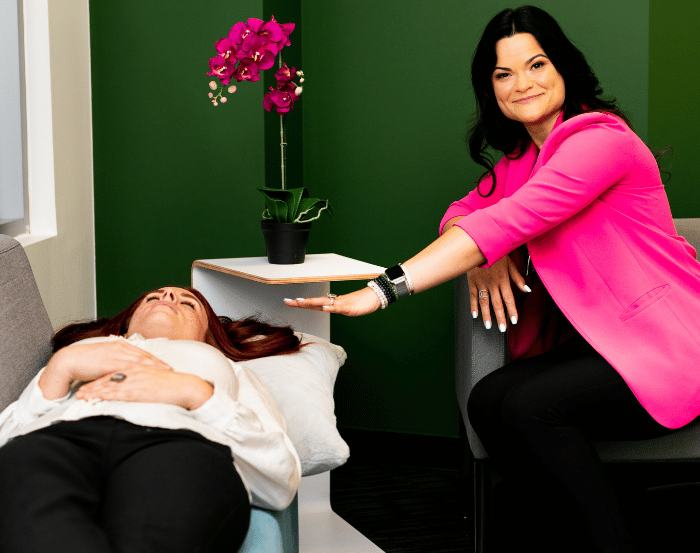
Hypnosis is a guided state of focused attention. During hypnosis, distractions may fade into the background and a person may become more responsive to suggestions connected to a goal. You are not asleep, unconscious, or under someone else’s control.
In a professional setting, hypnosis can be used as part of a structured, collaborative process. The person participating remains involved throughout the session. If you are considering hypnosis for adults, understanding the process can make the experience feel more familiar and less mysterious.
What does hypnosis mean?
Researchers and professional organizations generally describe hypnosis in terms of focused attention, reduced awareness of surrounding distractions, and an increased capacity to respond to suggestion. A suggestion might invite someone to imagine a sensation differently, rehearse a new response, or experience a familiar situation with greater calm.
Hypnosis is not the same as sleep. A person can usually hear what is being said, notice what they are experiencing, and choose whether to follow a suggestion. People also vary in how easily they become absorbed and how strongly they respond.
How does a hypnosis session work?
A session is shaped around the person’s goal, history, comfort, and response. Although practitioners use different methods, a session commonly includes the following steps:
- Conversation and goal setting. You discuss what you want to change, what you have already tried, and what would make the session useful.
- Focused attention. The practitioner may use breathing, imagery, progressive relaxation, or another method to help you narrow your attention.
- Therapeutic suggestions. Suggestions are connected to the agreed goal and may involve new perspectives, mental rehearsal, or different responses to triggers.
- Return to ordinary awareness. The practitioner guides your attention back to the room and gives you time to reflect on the experience.
Hypnosis is collaborative. Suggestions are not commands, and participation matters. A responsible practitioner should explain the process, invite questions, and respect your boundaries.
What does hypnosis feel like?
There is no single feeling that proves someone is hypnotized. Some people feel deeply relaxed. Others feel alert, absorbed, imaginative, physically light or heavy, or simply focused. The experience is sometimes compared with becoming immersed in a book, a film, music, or a familiar drive.
You do not need to lose awareness for hypnosis to be useful. Many people remember the session and can speak or move if they choose.
What can hypnosis be used for?
Clinical research has examined hypnosis for concerns that include some forms of pain, irritable bowel syndrome, anxiety associated with medical or dental procedures, menopausal symptoms, sleep, and smoking cessation. The strength of the evidence is not the same for every concern, and results vary from person to person.
Hypnosis should not be presented as a guaranteed cure. It can complement appropriate care, but it does not replace medical diagnosis, prescribed treatment, psychotherapy, or emergency mental health services.
What hypnosis cannot do
- It cannot reliably force someone to act against their values or consent.
- It does not make every person respond in the same way.
- It cannot guarantee a specific result or timeline.
- It should not be treated as a truth detector or a guarantee that a recalled event is factually accurate.
- It is not a substitute for qualified medical or mental health care when that care is needed.
Common hypnosis myths
Myth: Hypnosis is mind control
Hypnosis relies on attention, communication, expectation, and participation. A person is not turned into a passive observer with no choice.
Myth: You have to be unconscious
Most people remain aware of the practitioner’s voice and of what is happening during the session.
Myth: Responding to hypnosis means you are weak-minded
Responsiveness to hypnosis is not a measure of intelligence, character, or willpower. People naturally differ in absorption, expectation, and responsiveness to suggestion.
Frequently asked questions
Can everyone be hypnotized?
People vary in responsiveness. Many people can experience at least some hypnotic effects, while others respond less strongly. Comfort, expectations, the setting, the method used, and the working relationship can all affect the experience.
Can I get stuck in hypnosis?
No. Hypnosis does not trap a person in a permanent state. A person can naturally shift attention, end the exercise, or return to ordinary awareness.
Will I reveal private information?
Hypnosis does not remove your values or judgment. You remain able to decide what you do and do not want to discuss.
How many sessions will I need?
There is no universal number. The answer depends on the goal, its complexity, the approach being used, and the person’s response. Be cautious of anyone who guarantees an outcome within a fixed number of sessions.
Sources and further reading
- National Center for Complementary and Integrative Health: Hypnosis
- APA Dictionary of Psychology: Hypnosis
- American Psychological Association: The Science of Clinical Hypnosis
- Functional Changes in Brain Activity Using Hypnosis: A Systematic Review
Curious whether hypnosis is a fit for the change you want to make? Learn how adult hypnosis sessions are structured and what your next step could look like.
Explore hypnosis for adults